

Research Spotlights: A New Personalised Brain Model Links Brain Structure to Individual Brain Activity
.jpg)
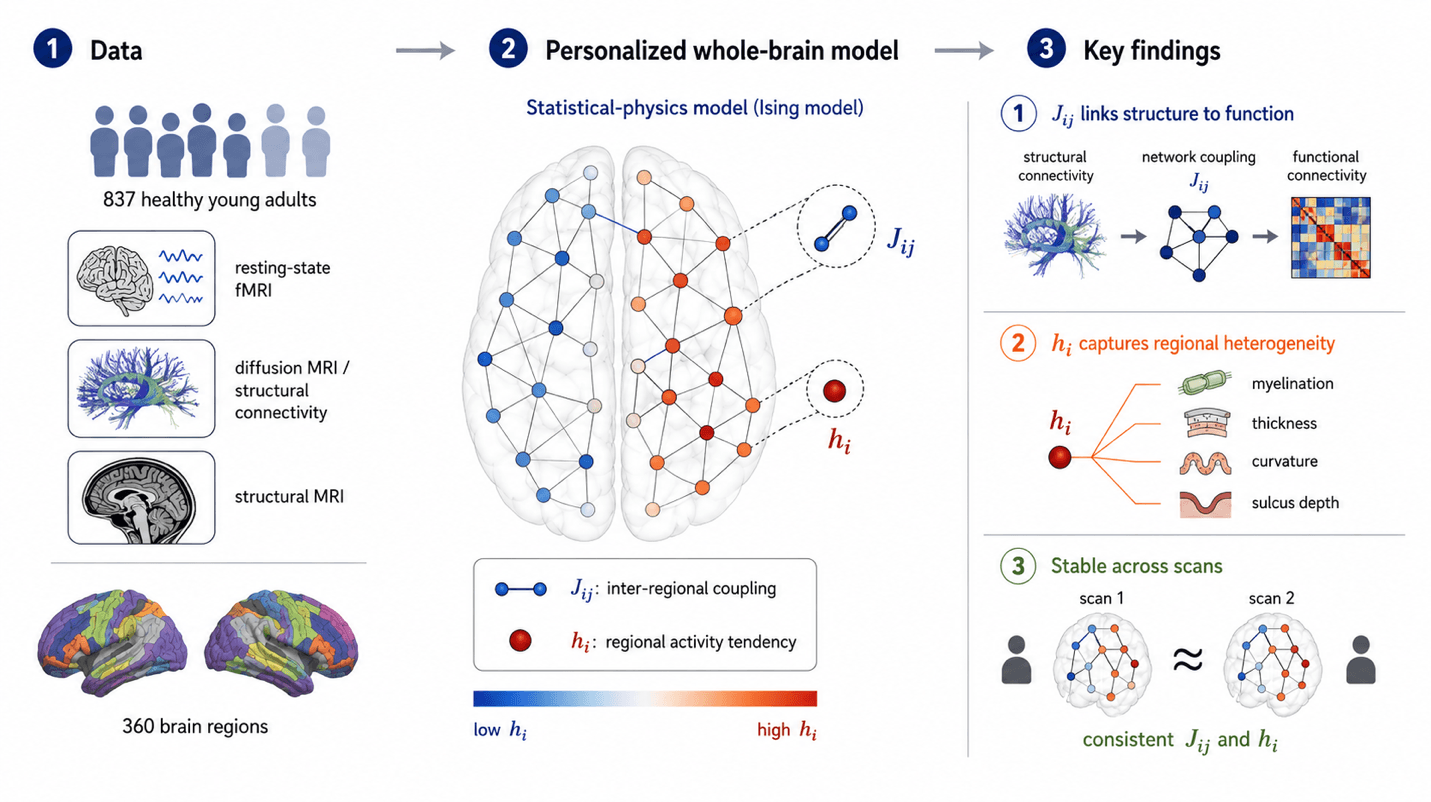 Why does each person’s brain activity look slightly different? Scientists often describe the brain as a complex network, where brain regions are like nodes and the connections between them are like roads. This view has been powerful, but it leaves out an important part of the story: brain regions are not all the same. Like different districts in a city, different brain regions have their own structural features and activity patterns.
A research team led by Professor ZHOU Changsong in collaboration with Professor TANG Qianyuan from the Department of Physics, developed a personalised whole-brain model based on statistical physics. The model is known as the Ising model, which was originally developed to study how many interacting units produce collective behaviour. In the study, each brain region is treated as one unit. The model captures both how brain regions influence one another and how each region has its own tendency to become more or less active.
Using multimodal brain imaging data from 837 healthy young adults in the Human Connectome Project, the researchers built individualised models at the scale of 360 brain regions. They found that one set of model parameters reflects how structural connections constrain brain activity, while another set captures the intrinsic activity tendency of each brain region. These region-specific parameters were linked to structural MRI features, including myelination, cortical thickness, curvature, and sulcus depth.
The study also showed that these model parameters are stable across different brain scans from the same person, suggesting that they capture meaningful features of individual brain organisation rather than random noise. By linking whole-brain network interactions with local differences among brain regions, this framework provides a new tool for understanding how brain structure shapes brain function. It may also support future research on mechanistic brain markers and personalised brain stimulation strategies.
The findings have been published in NeuroImage under the title “Personalized whole-brain Ising models with heterogeneous nodes capture differences among brain regions.”