

Congratulations to Professor ZHU Furong on his 𝘕𝘢𝘵𝘶𝘳𝘦 𝘊𝘰𝘮𝘮𝘶𝘯𝘪𝘤𝘢𝘵𝘪𝘰𝘯𝘴’ top 50 recently published papers (Editors’ Highlights) in physical sciences research The Art and Science of Translucent Color Organic Solar Cells
Congratulations to Professor ZHU Furong on his 𝘕𝘢𝘵𝘶𝘳𝘦 𝘊𝘰𝘮𝘮𝘶𝘯𝘪𝘤𝘢𝘵𝘪𝘰𝘯𝘴’ top 50 recently published papers (Editors’ Highlights) in physical sciences research The Art and Science of Translucent Color Organic Solar Cells
The Department of Physics is delighted to announce a recent publication, “The Art and Science of Translucent Colour Organic Solar Cells,” directed by Professor ZHU Furong, Associate Dean (Research and Postgraduate Studies) of the Faculty of Science and Chair Professor of the Department of Physics, has been featured in Nature Communications, Vol. 16, 2025 and selected as one of the 50 best papers recently published in physical sciences research, an accolade that underscores the global impact and innovation of HKBU’s research community.
A New Vision for Sustainable and Beautiful Buildings
As the world seeks sustainable solutions to meet growing energy demands, buildings have become a focal point—accounting for over a third of global electricity consumption. While traditional silicon-based solar panels are effective, their opaque and utilitarian appearance often limits their integration into modern architecture.
This research addresses this challenge by developing translucent colour organic solar cells (OSCs). These cells not only generate electricity efficiently but also offer vibrant, customisable colours and transparency. This innovation paves the way for building-integrated photovoltaics (BIPV) that are as beautiful as they are functional.
Scientific Breakthroughs: Where Efficiency Meets Art
The research represents a fusion of art and science, leveraging advanced materials and optical engineering. By incorporating narrowband non-fullerene acceptors and a Fabry-Pérot microcavity optical coupling layer, the team achieved a remarkable power conversion efficiency (PCE) exceeding 15% and a maximum transparency of over 20% for the three primary colours of red, green, and blue. This balance of efficiency and transparency is unprecedented in the field of coloured, semi-transparent solar cells.
A key innovation lies in the use of high-throughput optical computing and experimental optimisation. Professor Zhu and the team systematically analysed the relationship between device performance and colour, enabling precise control over completing indexes of the colour, transparency and electricity generation. This approach allows architects and designers to select from a wide palette of hues without sacrificing energy output.
A New Paradigm for Green Cities
To showcase the artistic potential of their technology, the researchers recreated Piet Mondrian’s iconic “Composition C (1920)” using a 10×10 cm² translucent OSC module. The module not only replicates the visual impact of Mondrian’s work but also generates electricity. The modular design is scalable, and the fabrication process is compatible with large-area manufacturing techniques. These translucent colour OSCs can be seamlessly integrated into windows, facades, skylights, and even greenhouses, transforming passive surfaces into active, power-generating elements that enhance the visual environment.
This pioneering work exemplifies HKBU’s commitment to interdisciplinary innovation and international collaboration. By harmonising energy generation with aesthetic design, the team has opened new possibilities for sustainable architecture and urban living, where every window can be a canvas, and every building a generator of clean, renewable energy, as illustrated in Figure 1.
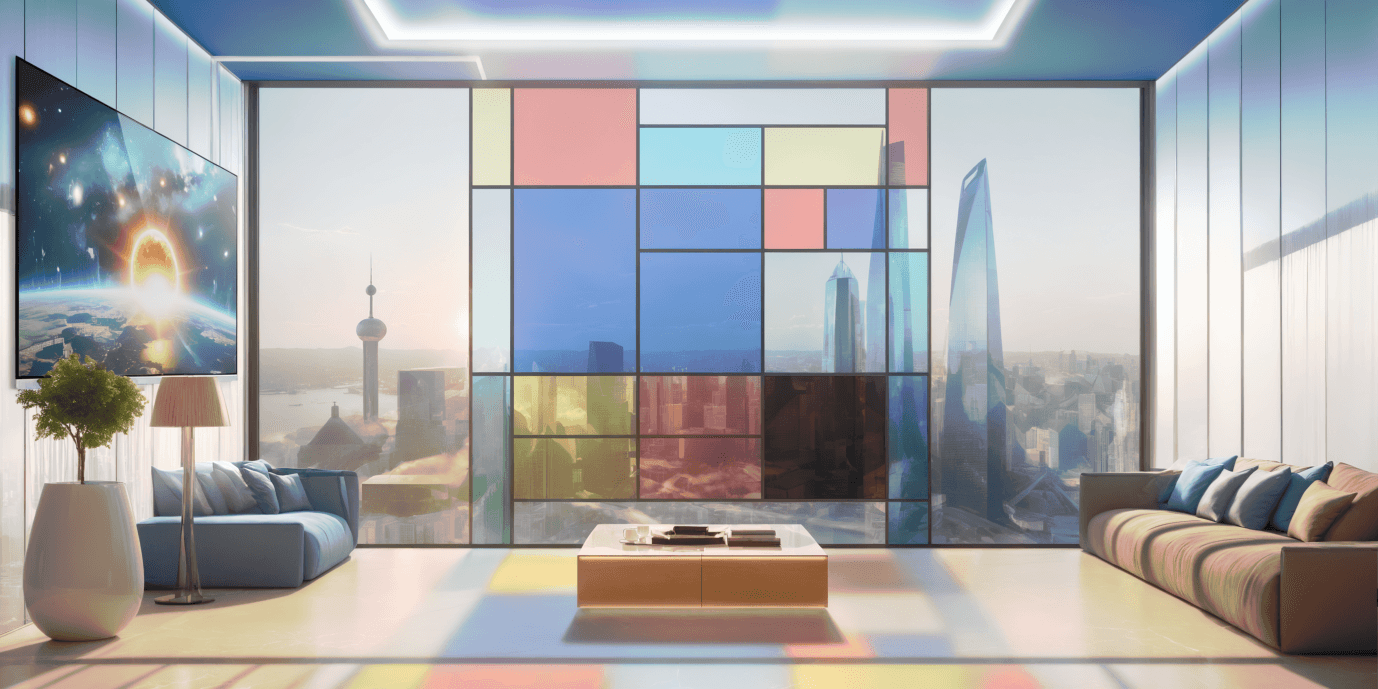
Figure 1. An enabling translucent colour BIPV technology: from power generating windowpanes to aesthetic art.
Source: HKBU Faculty of Science